
Disruption and complaints from commuters and local train passengers often make the news. For someone catching a regional train every morning, service quality also means minutes lost and missed connections. Let’s look at the situation through official figures.
The charts use RFI’s full-year 2025 results, with monthly and territorial detail. Average delays and cancellations come from Trenitalia’s 2025 quality report. The sources cover different sets of services: reading them together helps explain what each number measures.
In 2025, 90.1% of trains in the regional segment on the RFI network reach their destination within five minutes. The remaining 9.9% exceed the threshold, calculated as 100 − 90.1. All delay causes are included; this difference does not measure cancelled trains.
When does a regional train count as punctual?
Pay attention to the definition of punctual: within five minutes includes arrivals ahead of schedule, at the scheduled time and up to five minutes late. Even those few minutes can matter when you need to change trains.
Before comparing percentages, I check the period, network or operator, threshold, arrival point and exclusions. “No exclusions” includes all causes; a measure excluding strikes or exceptional events answers a different question. Arrival at the terminus does not necessarily describe the delay at the intermediate station where we get off.
The regional segment on the RFI network covers services from several operators. It is not limited to Trenitalia and does not cover every local railway in Italy. The percentage counts trains, not passengers: a crowded service and a quiet one involve different numbers of travellers.
Regional train punctuality month by month in 2025
The national series ranges from 88.7% in May to 92.2% in August. The chart shows changes throughout the year; it cannot establish their causes or predict the next journey.
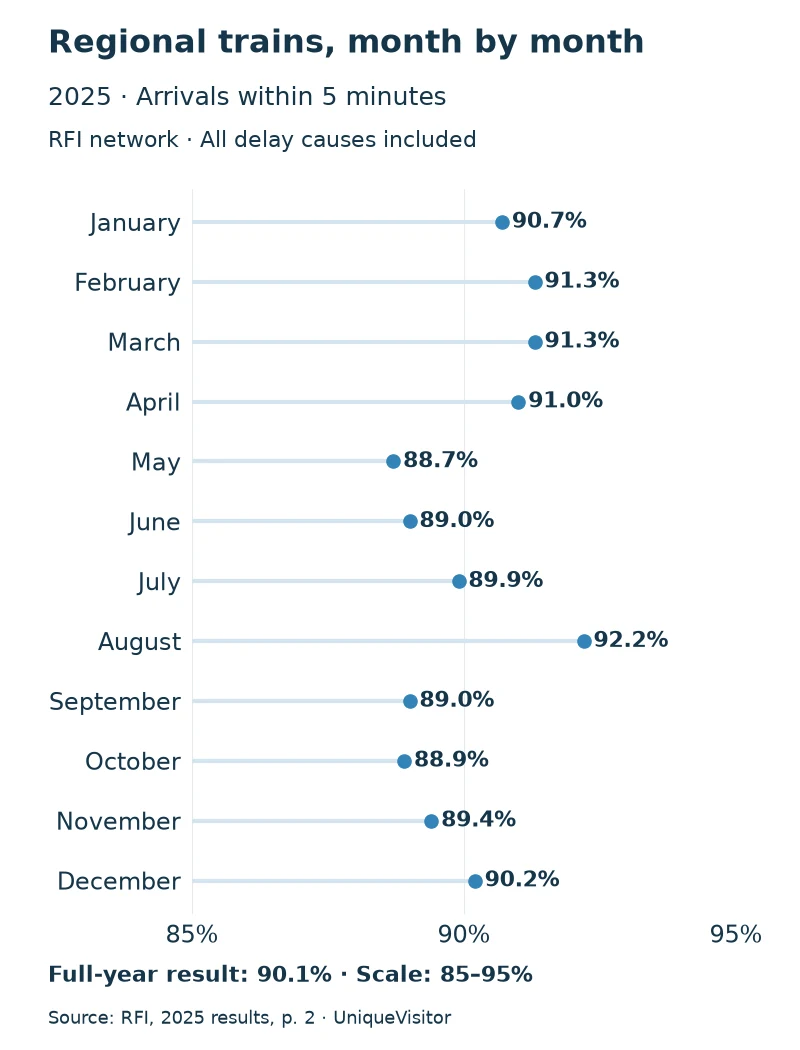
Read all monthly values
| Month | Within 5 minutes |
|---|---|
| January | 90.7% |
| February | 91.3% |
| March | 91.3% |
| April | 91.0% |
| May | 88.7% |
| June | 89.0% |
| July | 89.9% |
| August | 92.2% |
| September | 89.0% |
| October | 88.9% |
| November | 89.4% |
| December | 90.2% |
The 90.1% full-year result is published by RFI. I do not calculate it as a simple average of the twelve monthly percentages: the number of services can vary between months.
Where are regional trains most punctual?
RFI provides a consistent comparison across 15 territorial infrastructure directorates (DOIT). Cagliari and Palermo have the highest values; Milano and Genova have the lowest.
DOIT boundaries do not exactly match regional borders. “Milano” means the territorial directorate, not just Milano Centrale station or a figure automatically applicable to the whole of Lombardy. The same principle applies to the other areas.
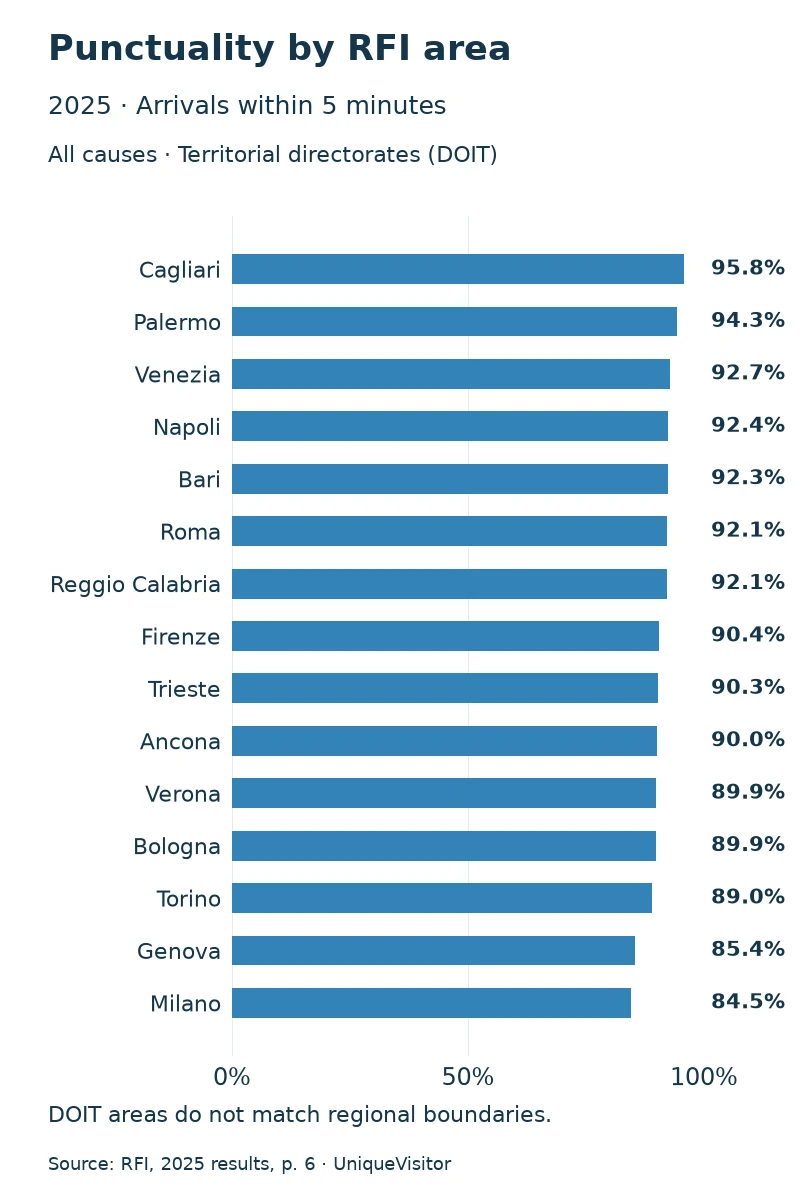
Read the figures for all 15 territorial directorates
| RFI territorial directorate | Punctuality |
|---|---|
| Ancona | 90.0% |
| Bari | 92.3% |
| Bologna | 89.9% |
| Cagliari | 95.8% |
| Firenze | 90.4% |
| Genova | 85.4% |
| Milano | 84.5% |
| Napoli | 92.4% |
| Palermo | 94.3% |
| Reggio Calabria | 92.1% |
| Roma | 92.1% |
| Torino | 89.0% |
| Trieste | 90.3% |
| Venezia | 92.7% |
| Verona | 89.9% |
The comparison describes the overall results of areas with different networks and traffic volumes. It cannot automatically attribute delays to the infrastructure manager, the train operator or a particular technical fault.
Cancelled trains, faults and average delays
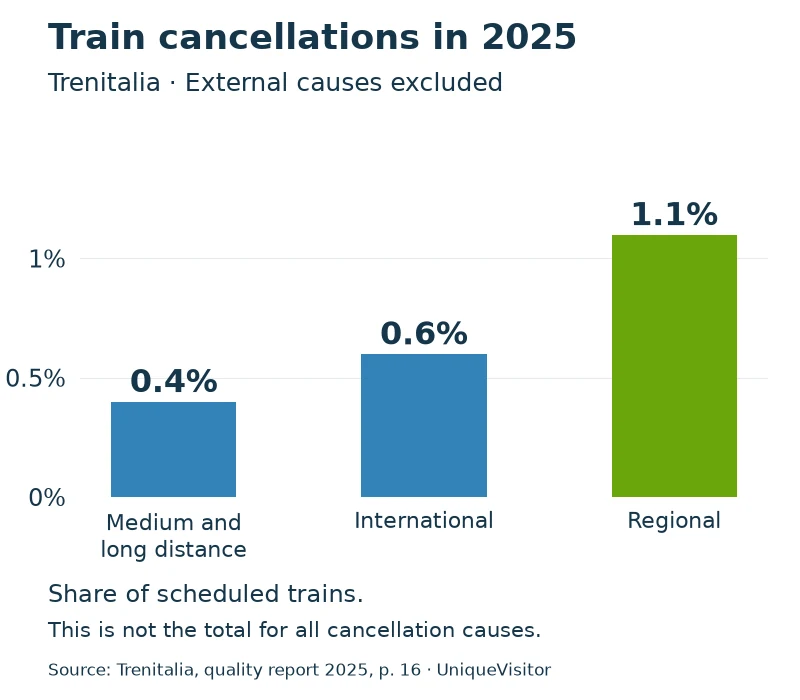
Trenitalia reports 1.1% of scheduled regional trains cancelled in 2025, excluding external causes. This is narrower than the total cancellations experienced by passengers. Source: Service Quality Report, page 16.
How much delay do Trenitalia regional trains accumulate?
| Measure | Result |
|---|---|
| Delay under 60 minutes | 99.9% |
| Delay of 60–119 minutes | 0.1% |
| Delay of at least 120 minutes | 0% (rounded value in the source) |
| Average arrival delay | 2.0 minutes |
Source: Trenitalia, page 14. “Under 60 minutes” includes a train arriving 50 minutes late. It does not mean “punctual”. The two-minute average is not the average of delayed trains only, and does not describe the wait during a particularly difficult incident.
What can these figures tell us about technical faults?
A cancelled train and a train with a technical fault are different observations. The national sources used here do not provide a current, consistent series of average daily service-stopping faults for every region, or 6–10 a.m. and 4–8 p.m. results for all areas. Cancellation percentages cannot replace these measures. For a problem affecting a particular line, check notices from the operator and infrastructure manager.
What do the 2026 updates tell us?
In its 3 July 2026 release, FSnews reports 91% punctuality for Regionale. This is an official FS Group update, but the text does not specify the exact measurement period or detail the exclusions. I therefore keep it separate from the annual RFI charts.
For comparisons across months and territories, I use RFI’s complete 2025 results. In the document titled “2025 Results – 2026 Targets”, values in the 2026 targets column are goals, not results already achieved.
Where to find figures and commitments for your region
For more detail on your service, start with Trenitalia’s official collection of regional Service Charters. Select the region to find local contract indicators, available results and targets. Always check the year actually measured and the table’s methodological note: a target is not an achieved percentage.
The collection provides access to Abruzzo, Basilicata, Calabria, Campania, Emilia-Romagna, Friuli Venezia Giulia, Lazio, Liguria, Lombardy, Marche, Molise, Piedmont, Puglia, Sardinia, Sicily, Tuscany, Umbria, Aosta Valley, Veneto and the autonomous provinces of Bolzano and Trento.
For Lombardy, also consult Trenord’s Quality Report; for Emilia-Romagna, see the Region and FER monitoring of punctuality and reliability. For other local operators, consult their own charter or quality report and the regional service contract.
How to check delays for your own regional train
Averages help explain service quality; when I need to travel, I focus on the particular train, day and section of the route I will use. First I check engineering works, closures and timetable changes, then follow the train on ViaggiaTreno or the Trenitalia app. For Trenord and other operators, I use their respective official channels.
For running information, see our guide to real-time Trenitalia information. To extend the comparison to Frecce, Intercity and Italo, read the train delay statistics.
For an important connection, I consider the time needed to change platforms and the available alternatives. An area’s annual punctuality does not give the exact probability of catching the next train.
Frequently asked questions
How often are regional trains in Italy delayed?
In RFI’s 2025 results, 90.1% reach their destination within five minutes. By subtraction, 9.9% exceed that threshold. The figure covers the regional segment on the RFI network and includes all delay causes; cancellations are a separate indicator.
Does a train five minutes late count as punctual?
Yes. An indicator measuring arrivals within five minutes includes trains up to five minutes late, as well as those arriving early or at the scheduled time.
Which areas have the most punctual regional trains?
In RFI’s 2025 comparison with no exclusions, Cagliari reaches 95.8% and Palermo 94.3%; Milano records 84.5% and Genova 85.4%. These are RFI territorial directorates, whose boundaries do not exactly match administrative regions.
How can I check the delay of my regional train?
For a Trenitalia service, check ViaggiaTreno or the Trenitalia app and line alerts. For other operators, use their official running information. Annual averages cannot predict an individual train’s arrival.