
The term “jet lag”, also written jetlag or jet-lag, combines jet, the aircraft, and lag, a delay or mismatch. In Italian it is also called “sindrome da fuso orario” or “mal di fuso”: time-zone sickness.
The mismatch affects the sleep/wake cycle and, more broadly, our circadian rhythms. It can occur when we fly rapidly across at least two time zones.
Let’s take a closer look at what happens, the symptoms and ways to manage them.

The circadian rhythm
The circadian rhythm is the cycle governing our biological clock. It influences:
- sleep and wakefulness;
- alertness;
- digestion;
- physical and intellectual performance;
- mood;
- hormone levels;
- body temperature.
Each cycle lasts approximately 24 hours and is influenced by internal and external factors. Internal factors come from a clock within our bodies that regulates these processes even without environmental cues. Experiments with men and women in enclosed spaces, isolated from the outside world, have helped researchers study this internal clock.
The cave stays of Maurizio Montalbini are well known: across several experiments, he spent a total of 962 days underground.
The main external cue is the alternation of light and darkness; meals and daily activities also help mark the day.
When a flight suddenly changes our time zone, our circadian rhythm is thrown off: day and night at the destination do not yet match our biological clock.
Our internal circadian rhythm is, on average, slightly longer than 24 hours. For many people, delaying sleep is easier than bringing it forward. That is why travelling west is usually easier to adjust to than travelling east. The speed of adjustment varies from person to person.
Jet lag symptoms
Symptoms can include:
- headache;
- nausea;
- exhaustion, tiredness and slower reactions;
- a heavy-headed feeling, confusion and difficulty concentrating;
- irritability, apathy or low mood;
- digestive problems and poor appetite;
- trouble falling asleep, waking during the night and daytime sleepiness.
Symptoms vary from person to person: some people are more sensitive to time-zone changes than others.
Age, sleeping and eating habits, stress, medication and sleep lost during the journey can also make a difference.
Ways to manage jet lag
If you travel regularly, you probably already have your own way of handling jet lag. Let’s look at useful strategies and a few tricks.
The ultimate aim is to synchronise our biological clock with the new local time.
First, consider whether you are travelling east or west.
Travelling west
Suppose we are flying from Rome to New York. New York is normally 6 hours behind Rome. The difference drops to 5 hours during the short periods when the United States and Europe change their clocks on different dates. Always check the date of your journey.

Travelling west effectively lengthens our day. Our bodies generally find it easier to delay the rhythm: try to follow the new local time and stay up until a normal bedtime at the destination, avoiding long afternoon sleeps.
Here is a calculation example, not a flight schedule. With a hypothetical 10-hour journey and a 6-hour difference, leaving Rome at noon would mean arriving in New York at 4 p.m. the same day. We could then have dinner and go to bed at a normal local time.
With the same assumptions, leaving at 3 p.m. would mean arriving at 7 p.m. Plan your rest on board so you can sleep during the destination’s night, without forcing yourself to stay awake at all costs.
Leaving at 8 p.m., still using this example, would mean arriving at midnight. Whether to sleep on the flight therefore depends on the actual schedule and how much sleep you have already had, not on one universal departure-time cut-off.
It generally helps to set your watch to the destination’s time so you can plan to sleep when people there are sleeping. Read the actual journey duration on your ticket, including any connections.
Travelling east
As we have seen, eastward travel often has a stronger effect because our bodies need to bring sleep forward.
This time, our day becomes shorter.
Suppose we are leaving Milan for the Maldives. The Maldives’ national time is UTC+5: it is 4 hours ahead of Italy during Italian standard time and 3 hours ahead during Italian summer time.

For a simple calculation, assume a 10-hour journey again. Leaving Milan at noon during Italian standard time would mean arriving in the Maldives at 2 a.m. the following night; during Italian summer time, at 1 a.m. Start thinking in destination time before departure and try to rest when it is night there.
With the same assumptions, a 3 p.m. departure would mean a 5 a.m. arrival the following morning, or 4 a.m. during Italian summer time. These are examples: use the actual times on your ticket to organise your rest.
Practical tricks, light and melatonin
We have seen how much sleep management matters, but falling asleep or staying awake is not always easy.
On board, avoid excess alcohol, which can disturb sleep, and limit caffeine and stimulating drinks in the hours before bedtime. Drink water, wear comfortable clothes and relax.
To sleep on a plane, bring a good eye mask and earplugs; some airlines provide the mask. When the crew allows it, lower the window shade to reduce outside light too.

Melatonin is a hormone our bodies produce in relation to the sleep/wake cycle. It signals biological night: production rises in darkness and is suppressed by light. Its peak falls during our biological night, which may not match local night during the first days of a trip.
Melatonin may help in some cases, but timing matters: taking it at the wrong time can shift the rhythm in the wrong direction. Speak to a doctor or pharmacist about whether to use it and the appropriate dose and timing, especially if you take other medicines.
Any use in the days after arrival should also be discussed: continuing automatically is not right for everyone.
Light is the main cue for shifting our circadian clock and synchronising the day/night and sleep/wake cycles. Darkness prepares us for rest alongside changes in body temperature and melatonin production.
Getting light at the right times can help the body adjust to its new schedule.
Generally, light during the biological morning brings the rhythm forward, while evening light delays it. This underlies the advice to seek morning light when travelling east and evening light when travelling west. After crossing many time zones, however, local morning may still be biological night. A personalised plan helps avoid counterproductive timing.
Natural light is useful; very bright artificial light can also affect the rhythm, but light-therapy devices require appropriate guidance.
Bring sunglasses to limit light exposure at the times indicated by your plan, without compromising safety while getting around.
A useful trick is to prepare ahead and gradually adjust your sleep/wake cycle in the days before departure. If travelling east, try going to bed and waking a little earlier; if travelling west, a little later.
Pace yourself on the first day and save demanding excursions for later. A brief nap may help if needed, but sleeping for a long time during the day can make nighttime sleep harder.
Recovery generally takes a few days. The rule of one day for every hour of time difference is only a rough guide: direction, number of time zones, lost sleep and individual characteristics affect the timing.
Our advice is to manage sleep sensibly without letting jet lag dominate your thoughts, while taking significant or persistent symptoms seriously.
Autogenic training
Autogenic training and other relaxation techniques can help settle the mind and body before sleep. They do not provide complete control over sleep or reset the circadian rhythm by themselves, but can complement a well-planned approach to rest and light.

Online tools and apps for managing jet lag
As we have seen, using daylight appropriately matters when shifting our circadian cycle.
Online tools and apps can help organise sleep and light exposure around a journey. Their plans are organisational aids, not medical prescriptions.
Jet Lag Rooster
Jet Lag Rooster is an online calculator for preparing a plan to adjust to a new time zone.
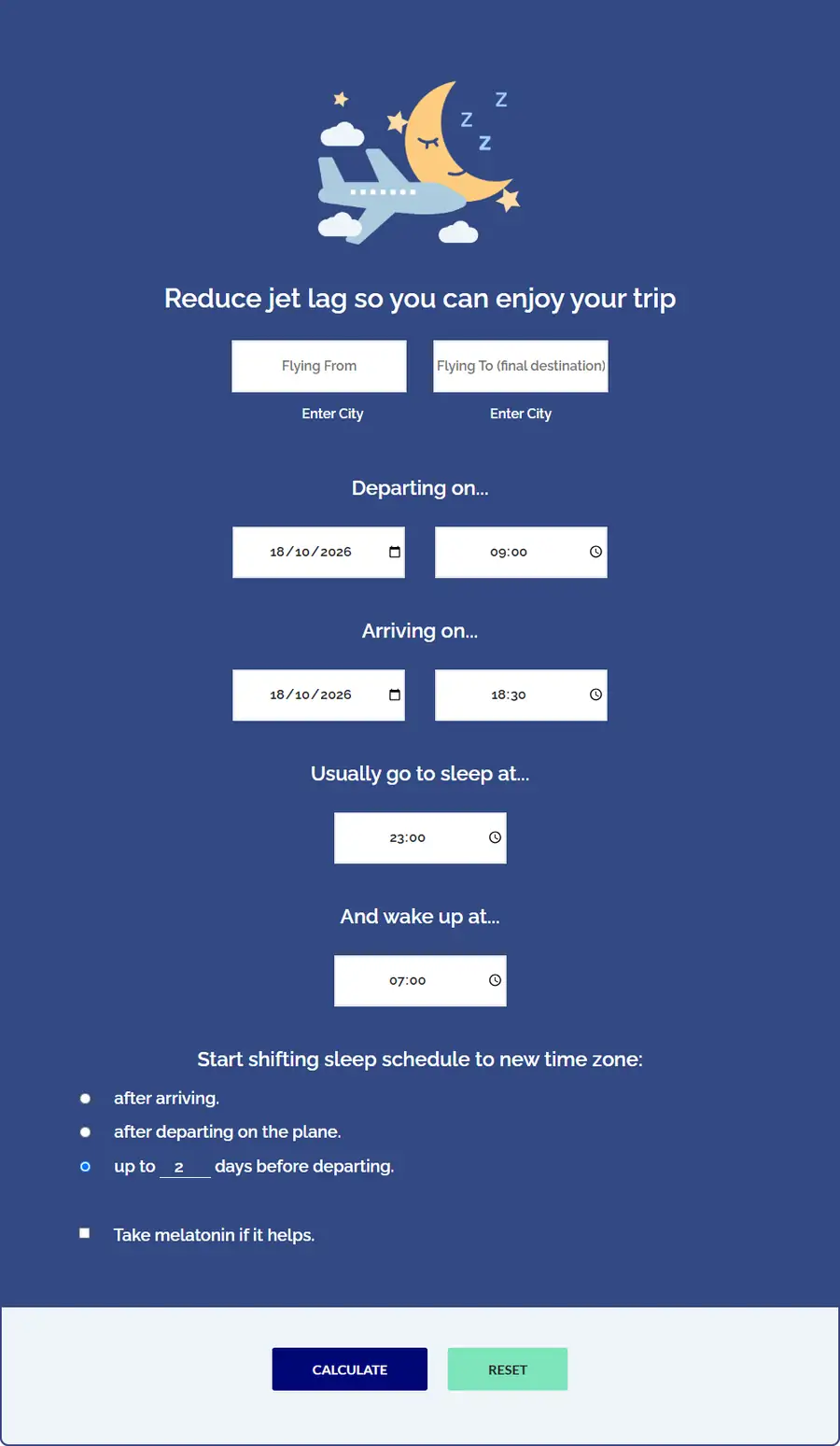
Enter the cities, dates, departure and arrival times and your usual sleeping hours. The service suggests when to seek or avoid light and when to rest. Consider its melatonin option only after speaking to a healthcare professional.

The website can also be used in a smartphone browser. For a dedicated app, see the alternative below.
British Airways
British Airways also offers an online tool, the Jet Lag Advisor.

Developed with sleep expert Chris Idzikowski, the service asks about your normal waking time, sleep quality and the time at home and at your destination to provide suggestions.
Jet lag apps: Timeshifter
Timeshifter provides personalised plans based on your itinerary and sleep habits, with guidance on light, rest, caffeine and optional melatonin.
It is available for iOS and Android. The developer’s website links to the app stores and explains the service terms.
Vasopressin
A study published in Science in 2013 by Japanese researchers showed the role of vasopressin receptors in how mice adapt to changes in the light/dark cycle.

The hormone also helps regulate water balance and blood pressure. In the study, the absence or blocking of specific vasopressin receptors helped animals adjust more quickly to an experimental change of schedule.
The finding suggests a possible avenue for research into drugs targeting circadian misalignment. It does not establish a ready-to-use cure for jet lag in humans or identify vasopressin as its sole cause.