
Whenever I pack for a trip, chargers for my phone, camera and laptop turn into a small collection of cables. Reaching a hotel and finding that the plug will not fit is inconvenient; connecting an appliance to the wrong voltage can damage it or create a genuine safety risk.
Before I leave, I check three things: voltage in volts, frequency in hertz and the socket shape. Only then do I choose an adaptor. Phones and laptops often need only a different plug shape; hair dryers, straighteners, kettles and other high-power appliances require a much more careful check.
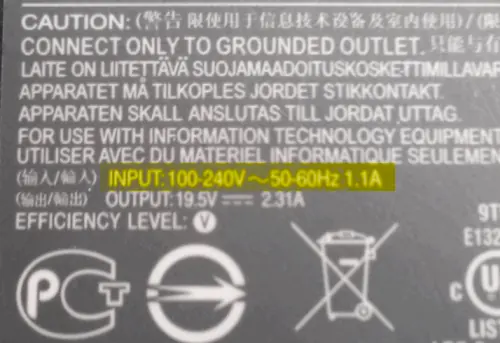
If the power supply says INPUT 100-240V 50/60Hz, it normally accepts the main electrical systems used worldwide and needs only the correct physical adaptor. If it lists a single voltage, do not plug it in until you have checked the local supply.

Voltage and frequency: what to check
Domestic supplies fall mainly into two broad families: roughly 100-127 V at 60 Hz and roughly 220-240 V at 50 Hz. This is not an absolute division. Japan uses 100 V with two frequencies, while some countries have more than one voltage or socket type. Check the exact destination rather than assuming that an entire continent follows one standard.
The label on the power supply gives the most reliable answer. INPUT states the voltages and frequencies it can receive. OUTPUT describes what the supply sends to the device and is not the value to use when deciding whether it can be connected to the wall.
| Destination | Domestic supply | Common sockets |
|---|---|---|
| Italy and much of Europe | 230 V · 50 Hz | C, F; also L in Italy |
| United Kingdom and Ireland | 230 V · 50 Hz | G |
| United States and Canada | 120 V · 60 Hz | A, B |
| Japan | 100 V · 50 Hz east, 60 Hz west | A, B |
| Australia and New Zealand | 230 V · 50 Hz | I |
| Argentina | 220 V · 50 Hz | I, C |
An adaptor changes the contact geometry but not volts or hertz. A converter or transformer changes voltage and must be rated for the appliance's power. Heat-producing appliances can easily exceed the capacity of small travel converters.
Electrical socket types
Plug and socket systems are identified by letters from A to N. The photographs show several common designs: C and F across much of Europe, L in Italy, G in the United Kingdom and Ireland, A and B in North America and Japan, and I in Australia, New Zealand and Argentina.
A country may use more than one standard, and older buildings can retain different sockets. Some plugs will physically fit a similar socket without providing the intended earth connection, so mechanical compatibility alone is not proof of a safe connection.

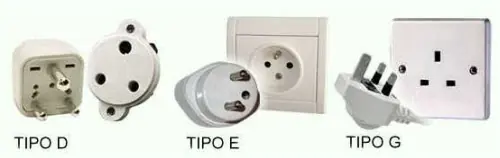
United Kingdom and Ireland: the Type G socket
Great Britain and Ireland use the Type G socket with three rectangular contacts. The nominal supply is 230 V at 50 Hz, so many European multi-voltage chargers are electrically compatible but need a physical adaptor. Type G is also used in Malta, Cyprus, Singapore, Malaysia, Hong Kong and several destinations associated with the British standard.
A British plug normally contains a fuse, and the sockets have internal shutters. If a device needs an earth connection, choose an adaptor that genuinely preserves it; compact two-pin adaptors are not suitable for every appliance.
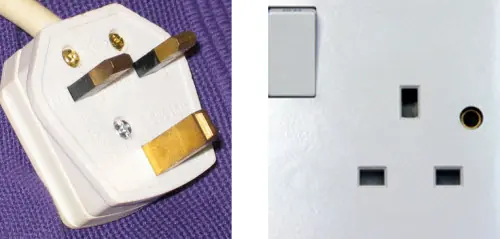
The adaptor-free method: why you should not use it
The video and photograph show a way of manually opening the socket shutters. Do not copy it: it can expose live parts, removes a safety barrier and does not solve earthing or electrical compatibility. The correct solution is an undamaged, certified adaptor suitable for the device.

United States, Canada, Central America and Japan
The United States and Canada mainly use Type A and B sockets with a nominal supply of 120 V at 60 Hz. Type A has two flat blades; Type B adds an earth contact. These formats are also common in Mexico, many Central American and Caribbean destinations and, with local differences, other countries.
Japan uses a lower voltage of 100 V. The frequency is 50 Hz in eastern Japan and 60 Hz in western Japan, including Nagoya, Kyoto and Osaka. Type A and B sockets may look like their North American counterparts, but the supply is not identical, so read the label before connecting a single-voltage appliance.

Australia, New Zealand and Argentina
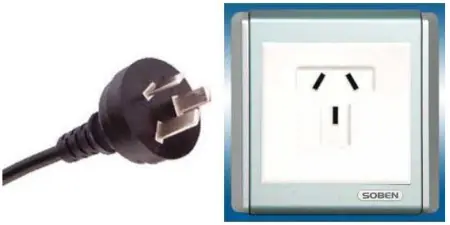
Australia and New Zealand normally use Type I sockets and a 230 V, 50 Hz supply. The same plug profile is found in Argentina, where the nominal value is 220 V at 50 Hz, and in other Pacific destinations. Mainland China may have A, C and I sockets, making a well-designed universal adaptor more practical than a single-purpose model.
A Type I plug has two angled blades and, on the earthed version, a third vertical contact. Even where the voltage is close to the Italian or European supply, an adaptor is needed because the shape is different.
Electrical plugs in Europe
Much of Europe uses 230 V at 50 Hz, but its sockets are not uniform. The small Type C Europlug fits many C, E and F sockets and is common on double-insulated chargers. The Type F Schuko has side earth contacts and is widely used in Germany, Austria, Spain, the Netherlands and many other countries.
Italy has C, F and L sockets. France and Belgium mainly use Type E, Switzerland Type J, Denmark Type K, and the United Kingdom, Ireland, Malta and Cyprus Type G. An old Italian three-pin L to two-pin C adaptor is suitable only where the device does not require an earth and the complete connection is approved for the expected load.


How to choose a travel adaptor
A universal adaptor is convenient when a trip crosses several countries, but a collection of sliders is not enough. It should clearly state its maximum voltage, current or power, support the source and destination plug systems, and preserve earthing when required. For the United Kingdom, the fuse and compliant shutters also matter.

- Read INPUT: 100-240V 50/60Hz normally identifies a universal power supply.
- Check the load: never exceed the amps or watts marked on the adaptor.
- Preserve earthing: a Class I appliance needs a continuous earth path.
- Avoid chains: do not daisy-chain adaptors or overload extension leads.
- Inspect it: do not use loose pins, distorted plastic, heat marks or exposed parts.
- Buy from a reputable retailer: printed marks and claims alone do not prove that a product is safe.
For phones and laptops, I prefer to take my own USB or USB-C charger and connect it to the hotel socket through the adaptor. Built-in hotel USB ports may be slow; using your own power supply makes its power and compatibility easier to assess.
Frequently asked questions about plugs and travel adaptors
Does a travel adaptor also change the voltage?
No. An adaptor only changes the physical shape of the plug. Changing voltage requires a converter or transformer rated for the device and its power consumption.
Can I charge my phone and laptop abroad?
Usually yes if the power supply says INPUT 100-240V 50/60Hz. You then normally need only a physical adaptor for the local socket, but you should always read the label first.
Can I use a European hair dryer in the United States or Japan?
Only if its voltage range includes the local supply. Hair dryers, straighteners and kettles draw substantial power and are often single-voltage devices, so a simple adaptor is not enough.
Which adaptor do I need in the United Kingdom and Ireland?
You need a Type G adaptor suitable for the device's power and earthing requirements. Never use an object to open the socket shutters manually.
What voltage and frequency are used in Japan?
Japan uses 100 V. The frequency is 50 Hz in eastern Japan and 60 Hz in western Japan; Type A and B sockets are the most common.
Is a universal adaptor suitable for every device?
No. It must support the socket, power and earthing required, and the device itself must accept the voltage and frequency of the local supply.